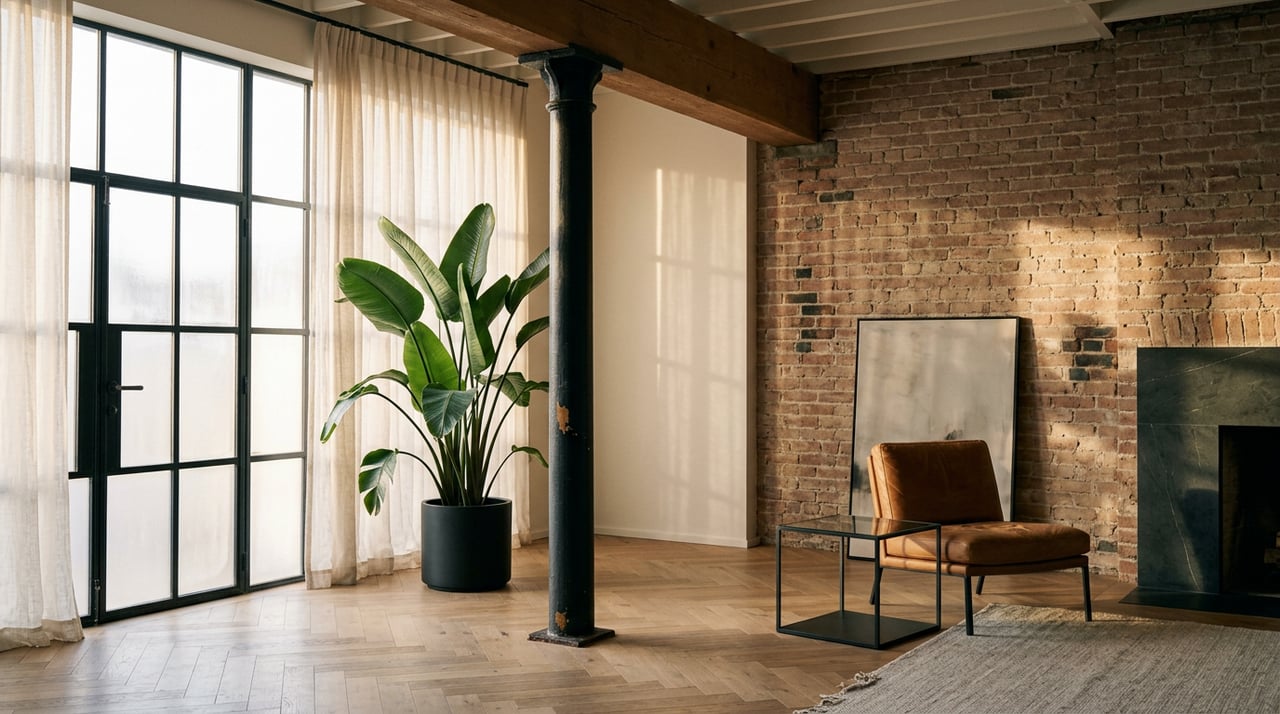
Two lofts go on the market the same week, both on cast-iron blocks between Broadway and Greene Street, both roughly 2,400 square feet, both listed within a few dollars of each other on a price-per-square-foot basis. A buyer touring them would be forgiven for treating them as interchangeable. They are not. One of them can be sold to anyone. The other, depending on a certificate filed decades ago, may require its new owner to write a check for close to a quarter million dollars before they can legally live there as anything other than a certified artist.
The line between those two lofts has nothing to do with renovation quality or ceiling height. It runs through a piece of New York's zoning history that most out-of-market buyers have never heard of, and that even seasoned Manhattan agents sometimes underweight: the Joint Living-Work Quarters for Artists designation, known as JLWQA, and the fee now attached to escaping it.
A Zoning Fossil With a New Price Tag
JLWQA dates to 1971, when the city carved out a narrow exception in SoHo's manufacturing zoning to let state-certified artists legally live in the industrial lofts they had already colonized. For decades, enforcement was minimal to nonexistent. Artists sold to non-artists, non-artists sold to other non-artists, and the certificate of occupancy on file quietly stopped matching who actually lived there.
The city tried to resolve this contradiction with its December 2021 SoHo/NoHo rezoning, which created the Special SoHo-NoHo Mixed Use District. The rezoning gave JLWQA occupants a voluntary path to convert their units to unrestricted residential use. The price of that path: a one-time, non-refundable contribution to the SoHo-NoHo Arts Fund, set at $100 per square foot of floor area being converted and indexed to rise annually. On a 2,000-square-foot loft, that is a $200,000 line item that has nothing to do with the mortgage.
The city framed this as generous. A group calling itself the Coalition for Fairness in SoHo and NoHo, made up of residents and unit owners, framed it as an unconstitutional toll on people who had done nothing wrong. That disagreement went to court, and for four years it stayed unresolved.
January 13, 2026: The Fee Becomes Law, Not Just Policy
In December 2024, the Appellate Division sided with the coalition, ruling unanimously that the Arts Fund fee violated the Takings Clause and blocking the city from collecting it. For a little over a year, SoHo loft buyers and sellers were negotiating in a legal gray zone, unsure whether the conversion fee would survive.
That uncertainty ended on January 13, 2026, when New York's Court of Appeals reversed the Appellate Division in a 6-1 decision. The court's opinion held that petitioners lacked a compensable property interest under the Takings Clause, reasoning that a standalone monetary condition on an optional permit does not amount to a government taking. Bloomberg Law reported that the ruling rejected the coalition's argument that the fee infringed on residents' property rights, and The Real Deal covered the decision as a win for the city's original 2021 framework.
What this means in practice is not new law so much as restored law. The conversion pathway that existed on paper since 2021 is now enforceable, and owners who want to convert can pay the fee, record the required instruments, and receive certification from the Department of City Planning. The fee itself did not go up or down because of this ruling. What changed is that it is no longer optional to ignore.
Two Lofts, One Block, Different Exposure
Here is where most buyer conversations go wrong, because the fee does not apply evenly across SoHo's loft stock. A 2023 settlement between the city and building owners established that units registered as Interim Multiple Dwellings under the state's Loft Law are exempt from both the artist-certification requirement and the Arts Fund contribution, regardless of what the certificate of occupancy says.
| JLWQA unit, pre-1982 building | IMD unit, post-1982 Loft Law coverage | |
|---|---|---|
| Occupancy restriction | Legally requires a DCLA-certified artist or a protected occupant under MDL §276 | No artist certification required |
| Arts Fund exposure | Fee applies on conversion to unrestricted residential use | Exempt from the fee entirely |
| Governing framework | NYC Zoning Resolution §143-13, Special SoHo-NoHo District | State Loft Law, overseen by the NYC Loft Board |
| Path to clean title | Chairperson certification plus recorded Arts Fund contribution | Already treated as legal residential use |
The dividing line runs roughly along 1982, the year the state's Loft Law took effect. Buildings that were developed, co-oped, and issued a JLWQA certificate of occupancy before that law took hold generally fall on the fee-exposed side. Buildings that entered Loft Board jurisdiction as Interim Multiple Dwellings, many of them built or converted afterward, are carved out. On paper, that is a legal footnote. In a purchase negotiation, it is the difference between a clean closing and a six-figure surprise.
The Bargaining Chip Hiding in the Footnotes
Once a fee becomes real money, it becomes a negotiating position. A local publication that covers the neighborhood closely, SoHo Journal, has reported that buyers facing the fee often use it to push for price reductions on the theory that the seller, not the buyer, should absorb a cost tied to the building's legal status rather than its condition. That same coverage noted something that cuts the other way: since the artist-certification requirement was written in 1971, the city had never fined a non-artist occupant for noncompliance, let alone pursued eviction, which is part of why some longtime residents dismissed the fee fight as overblown.
That calculus may not hold going forward. Enforcement restraint made sense when the entire framework's legality was in question. Now that the Court of Appeals has confirmed the city's authority to collect the fee and certify conversions, the incentive structure shifts. A framework that regulators can enforce with legal confidence is a different animal than one tied up in litigation, even if actual enforcement patterns take time to change. Buyers pricing this risk in 2026 are pricing a legal environment that looks meaningfully different than it did in 2023.
What the Median Doesn't Explain
Anyone shopping SoHo loft comps this summer will find data that seems to contradict itself. Public housing data trackers show SoHo's median sale price over the three months ending April 2026 at roughly $3.2 million, down about 17 percent from the same period a year earlier, with price per square foot near $1,900 and homes sitting on market for around 106 days compared with 63 days the year before. Other home-value trackers, using a different methodology built on estimated values rather than closed comparable sales, put SoHo's average home value up about 7.5 percent year over year as of mid-2026.
Both figures can be accurate at the same time. SoHo closes a small number of transactions relative to Manhattan overall, which means a handful of large or unusually priced deals can swing a median sharply in either direction from one quarter to the next. The neighborhood's product mix compounds this. A raw, pre-war JLWQA loft with deferred maintenance and an unresolved zoning question sells at a very different multiple than a fully converted, board-approved condo loft two doors down, and a quarter with more of one type closing than the other will move the median without reflecting any real shift in what buyers are willing to pay for comparable space.
This is the practical argument for treating zoning status as a pricing input, not paperwork to handle after contract. In a market this volatile on paper, the headline median tells a buyer less about what a specific loft is worth than a clear answer to one question: is this unit exposed to the Arts Fund fee, and if so, has anyone priced that into the number on the listing sheet.
Documents to Pull Before You Write an Offer
- The current certificate of occupancy, checked against the unit's actual use group designation
- LPC and DOB job history for the building, since most SoHo buildings sit inside the Cast-Iron Historic District and any exterior work, including through-wall HVAC, requires Landmarks review
- Confirmation of Interim Multiple Dwelling status with the NYC Loft Board, which determines whether the Arts Fund fee applies at all
- Evidence of continuous occupancy since December 15, 2021, if relying on the MDL §276 grandfather protection rather than artist certification
- A renovation budget that accounts for landmarked-building realities. Full gut renovations in SoHo often run from the low $600s to well over $1,000 per square foot, and Landmarks approval timelines for exterior or street-visible work can add anywhere from a few weeks to several months depending on whether the project requires a public hearing
None of this is exotic due diligence by Manhattan standards. It is simply due diligence that has to happen before the offer, not after, because the fee is not a renovation cost that a buyer can phase in over time. It is a closing-table number.
A Few Questions Worth Asking Directly
Does this affect every SoHo loft? No. It applies specifically to units carrying a JLWQA designation in pre-1982 buildings that have not already converted or entered Loft Board jurisdiction as an Interim Multiple Dwelling. Many SoHo condos and co-ops were never subject to the restriction at all.
Can a seller be compelled to convert before selling? No. Conversion remains voluntary. A JLWQA unit can be sold as-is, with the buyer inheriting the same occupancy restriction and the same option to convert later.
Does the fee affect financing? Lenders generally want a clear residential certificate of occupancy. A unit still carrying JLWQA status, particularly one relying on a temporary CO, can complicate both financing and title insurance, which is another reason to resolve the question before signing rather than during underwriting.
Zoning history this specific rarely shows up in a listing description, and it will not show up in a median price chart. It shows up when a buyer's attorney pulls the certificate of occupancy three weeks before closing and finds a designation nobody mentioned at the open house. Après Global works through these questions before an offer goes in, not after, because in a market where the headline number tells you less than the paperwork does, the paperwork is the deal. If you're evaluating a SoHo loft, or trying to understand what a listing's zoning status actually means for your closing, request a private consultation and we'll walk through it with you directly.